
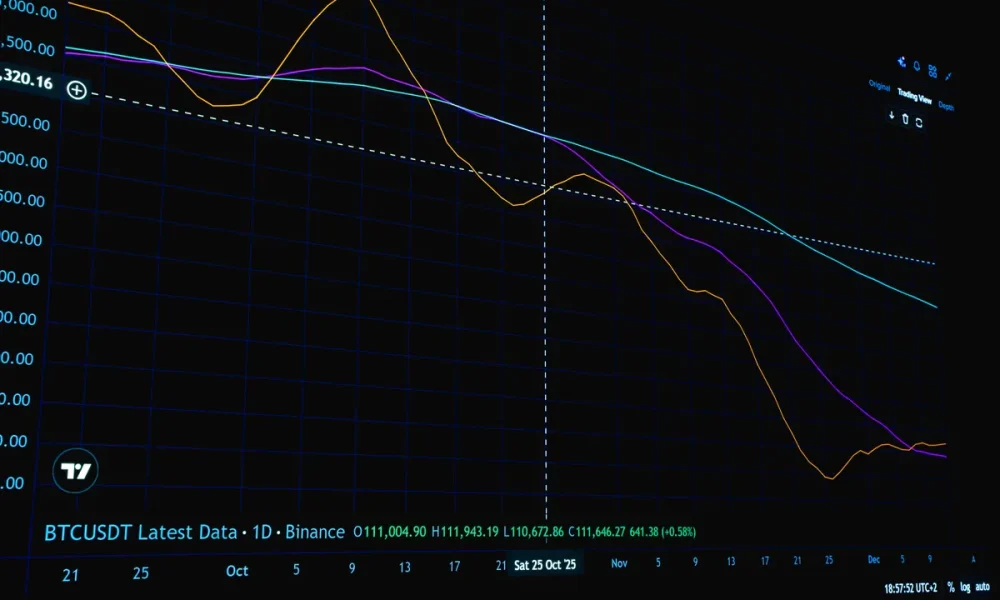
Three stock market crash risks are converging simultaneously: stretched AI-era valuations, bond yields that make equities look expensive, and a renewed build-up in margin debt that now exceeds $1.5 trillion. None of these is new in isolation. Together, the combination is worth examining more carefully than the usual late-cycle warnings.
The Three Stock Market Crash Risks in Detail
Start with valuations. The companies driving the artificial intelligence rally are trading at multiples that analysts have repeatedly compared to the dot-com era. That comparison can be overused, but the underlying logic holds: even if the technology delivers on its promise, prices can overshoot fundamentals by a wide margin before the correction arrives.
Bond yields add a second layer of pressure. The US 30-year Treasury yield remains above 5%, and as the 10-year approaches that level, the relative attraction of equities weakens. Government debt offering yields in that range is a genuine alternative for institutional allocators, not merely a theoretical one.
The third factor is leverage. According to FINRA’s official margin statistics, debit balances in US customers’ securities margin accounts reached $1.502 trillion in June 2026. By August 2026, the figure had eased to $1.45 trillion, but that still represented a 37.2% increase compared with the same month a year earlier, according to data from Advisor Perspectives. When margin debt unwinds, it tends to do so quickly: forced selling feeds on itself, amplifying moves that fundamentals alone would not produce.
These three stock market crash risks do not guarantee a sell-off, and timing them is largely futile. What they do is change the risk profile of a portfolio that has not been stress-tested recently.
Schroders as a Case Study in Defensive Positioning
For investors looking at where to add resilience without abandoning equities entirely, asset managers with strong balance sheets and long dividend histories are one place to look. Schroders (LSE: SDR) has attracted attention on both counts.
The shares are up 43% year to date, yet the price-to-earnings growth ratio sits around 0.14, suggesting growth is not fully priced in. The company has paid dividends for 27 consecutive years. Its official dividend record shows the 2026 interim dividend was set at 7.0 pence per share, with a record date of 7 August 2026 and payment date of 20 August 2026. One detail worth registering: the company suspended its Dividend Reinvestment Plan in respect of that interim payment, meaning shareholders received cash rather than reinvested shares.
The fundamental backdrop has some support. For the half-year ended June 2026, Schroders posted earnings per share of 0.221 against a consensus forecast of 0.199, an 11% positive surprise, on revenue of £1.37 billion against a forecast of £1.27 billion, according to Investing.com’s earnings data. These are aggregator figures pending confirmation from the company’s own filings, but the direction is consistent with a business that has been executing.
The group’s 2025 annual report sets out a three-year strategic plan targeting annualised cost efficiencies of £150 million by end of 2027, with the adjusted cost-to-income ratio targeted below 70% by the same date. Schroders Capital, the private markets division, carries associates and joint ventures assets under management of £94.1 billion across private equity, private debt and credit alternatives, real estate, and infrastructure. That diversification into private markets gives the group revenue streams that are less directly correlated with daily public-market swings.
Market capitalisation stands at approximately £9.1 billion. The risks are real: fee compression across active management is structural, not cyclical, and a prolonged equity downturn would reduce assets under management and therefore revenues. No dividend track record survives an existential balance-sheet event, though Schroders’ debt position does not currently raise that concern.
How to Position a Portfolio Against These Risks
The standard playbook for this kind of environment involves three moves: maintaining a cash buffer, holding shares in sectors where demand is less economically sensitive, and avoiding the temptation to sell everything when headlines deteriorate. Panic selling in a downturn crystallises losses that a patient investor can often recover; forced selling by margin-account holders is different in nature, because the decision is made by the broker, not the investor.
Reducing leverage exposure in a portfolio is the most direct response to a world where margin debt is running 37% above year-ago levels. Beyond that, the case for holding companies with conservative balance sheets, long dividend histories, and revenue streams that span multiple market environments becomes stronger as the cycle matures.
Schroders’ strategic plan runs through end-2027, with the cost-to-income target and the Schroders Capital growth objectives as the next measurable waypoints. How the group tracks against those targets over the next two reporting periods will tell investors whether the current valuation discount is an opportunity or a warning.

 Bitcoin
  Ethereum
  Tether
  BNB
BNB  USDC
USDC  XRP
XRP  Solana
  TRON
TRON  Lido Staked Ether
  Cardano
  Gram (prev. Toncoin)
  Avalanche